
Single Review—Sunrise in Rio
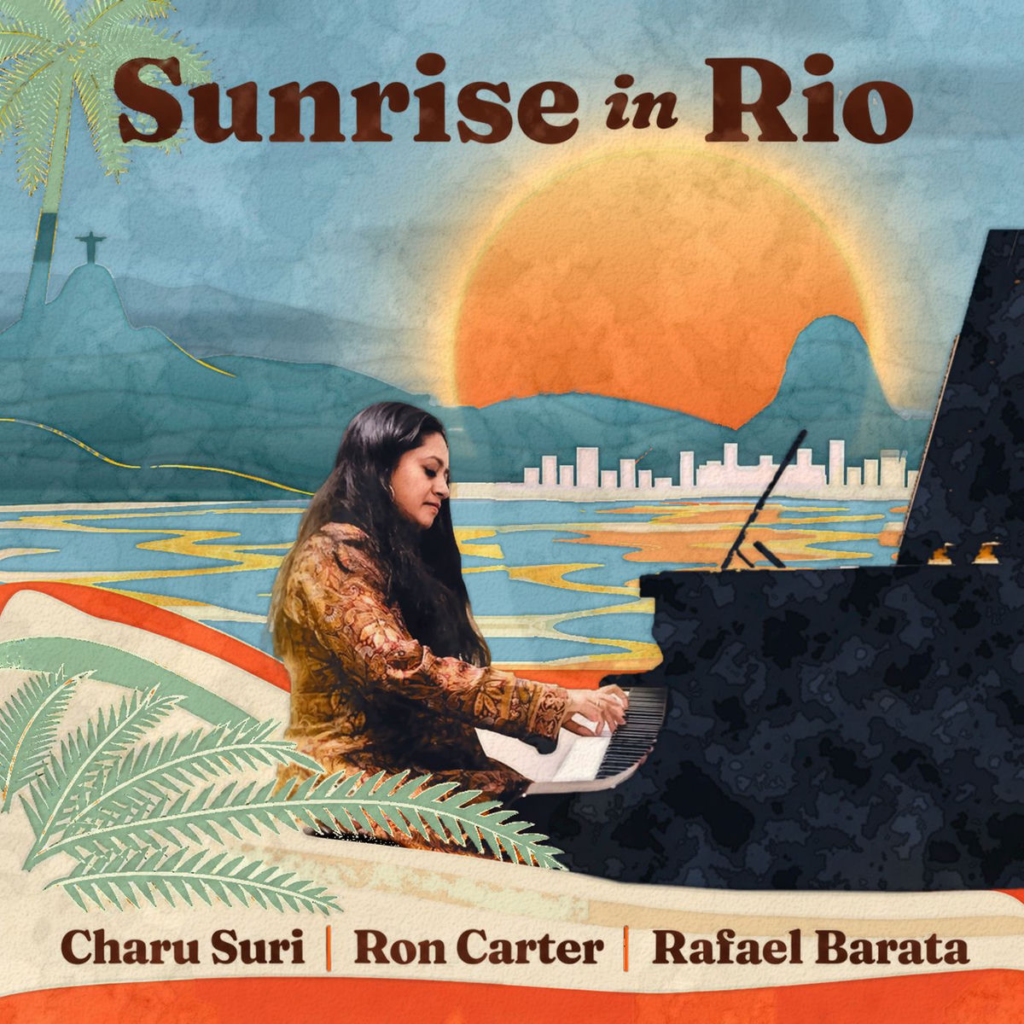
When Indian Raga Tradition Meets Brazilian Musical Expression: A Review of Charu Suri’s Sunrise in Rio
Music has always possessed the remarkable ability to transcend geographical boundaries and cultural identities. Sunrise in Rio, an instrumental single by pianist and composer Charu Suri, featuring legendary bassist Ron Carter and Brazilian drummer Rafael Barata, explores this possibility through an interesting combination of Indian classical influences, jazz and Brazilian musical expression. Lasting 4 minutes and 57 seconds, the composition introduces an artistic concept that brings together distinct musical traditions within a contemporary instrumental framework.
The Significance of Shankarabharanam
One of the most interesting aspects of this composition is its foundation in Shankarabharanam, a prominent raga of the Carnatic classical tradition, as identified by Charu Suri herself. Classified as the 29th melakarta raga in the 72-melakarta system, Shankarabharanam employs all seven musical notes in both ascending and descending movements. Its basic note structure corresponds to the Western major scale, although a raga’s identity extends far beyond its notes to include characteristic phrases, ornamentations and melodic expressions. Its rich musical heritage, reflected in numerous celebrated Carnatic compositions, makes it a particularly interesting choice for a contemporary cross-cultural project.
A Musical Connection with Sunrise
Shankarabharanam is traditionally associated with the morning hours, reflecting the Indian classical understanding of time-specific ragas. This association adds an interesting conceptual dimension to the title Sunrise in Rio. The imagery of a Brazilian sunrise meets an Indian musical tradition that recognises the relationship between melody and different periods of the day. It is a thoughtful cultural connection that lends the composition an identity extending beyond its geographical reference.
Exploring the Bossa Raga Concept
The Brazilian influence introduces another dimension to the composition. Bossa nova, which originated in Brazil, evolved through an interaction of samba rhythms, jazz harmonies and a distinctive approach to musical restraint. Its characteristic rhythmic sensibility offers an interesting setting for exploring the melodic possibilities of Indian ragas. The Bossa Ragaconcept therefore represents an attempt to bring together Indian melodic traditions and Brazilian musical influences while drawing upon the improvisational language of jazz.
Charu Suri’s Musical Journey
Born in Madurai and raised in Chennai, Charu Suri began her musical education at an early age, developing an association with both the piano and the veena. Her subsequent exposure to Western classical music and jazz gradually led her towards a deeper exploration of Indian musical traditions. Rather than simply conforming to established musical conventions, she began developing an individual artistic identity that could incorporate her cultural roots into contemporary instrumental music. Her earlier projects, including The Book of Ragas, The Book of Ragas Volume II, Rags & Ragas and Ragas & Waltzes, reflect this continuing exploration.
International Recognition and Achievements
Charu’s artistic journey has earned considerable international recognition. Her album Shayan received a Grammy nomination in the Best Contemporary Instrumental Album category, while her other achievements include Josie Music Awards, InterContinental Music Awards and Global Music Awards. Her compositions have also been performed by distinguished musicians and orchestras. These accomplishments reflect her growing presence in the international instrumental music landscape and her commitment to exploring the possibilities of Indian musical influences.
An Accomplished Musical Collaboration
The participation of Ron Carter adds considerable significance to Sunrise in Rio. With a career spanning several generations of jazz musicians, Carter is among the most respected bassists in jazz history. Brazilian drummer Rafael Barata brings his own musical background to this international collaboration, complementing Charu’s artistic vision. The combination of piano, bass and drums provides the instrumental foundation for a project that seeks to connect different musical cultures through a shared creative language.
Beyond Conventional Musical Boundaries
The significance of this release lies largely in its artistic conception. Cross-cultural musical collaborations are not new, but meaningful encounters between different traditions require more than simply bringing together musicians from different backgrounds. They involve an understanding of the musical languages concerned and an appreciation of their individual identities. Sunrise in Rio offers an opportunity to consider how Indian classical influences can find a place within contemporary jazz and Brazilian musical expression. For listeners familiar with Carnatic music, the reference to Shankarabharanam provides an additional point of interest, while others may find it an accessible introduction to the possibilities of raga-based instrumental compositions.
Take Away
Sunrise in Rio is an interesting contribution to contemporary cross-cultural instrumental music. Its appeal lies in the musical traditions it draws upon, the accomplished musicians involved and Charu Suri’s continuing exploration of her Indian musical roots through an international artistic vocabulary. As the lead single from her forthcoming album Bossa Raga, it also offers a glimpse into a broader musical journey. In an increasingly interconnected musical world, such explorations remind us that traditions need not remain confined to their geographical origins; they can interact, evolve and discover new avenues of expression while retaining their distinctive identities.
 Album Review—Journey
 Single Review—Tennessee Sunshine
 Single Review—Healing
 Single Review—Kyrie
 Single Review—Believe in Yourself
 Single Review—Belong
 Single Review—Sunrise in Rio
 Album Review—Aphelion
 Album Review—Surrender