
Album Review—Fractured Reflections
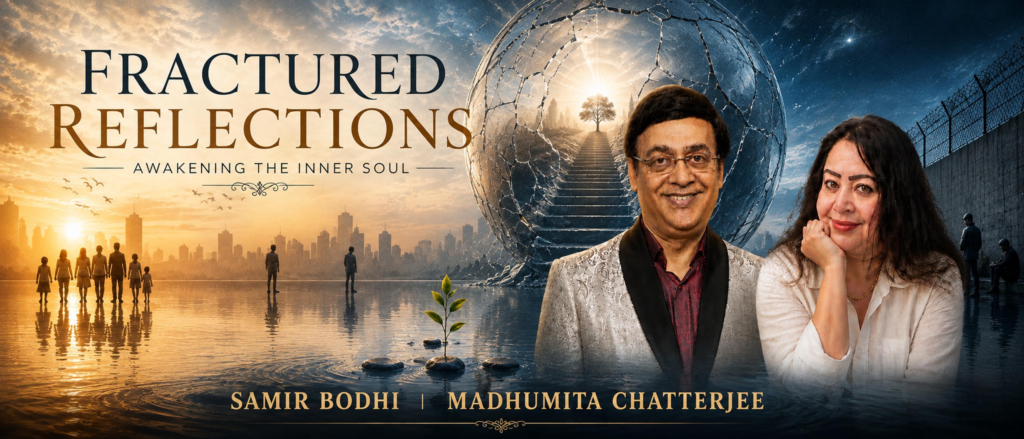
Finding Connection in a Fragmented World: A Review of ‘Fractured Reflections’ from Samir Bodhi and Madhumita Chatterjee
Fractured Reflections, the latest album from Samir Bodhi and Madhumita Chatterjee, invites us to slow down and look within at the emotions that quietly shape our lives. Inspired by hope, resilience, loss, belonging and the search for meaning in an increasingly divided world, the album turns these deeply human experiences into a thoughtful musical journey. Blending world music, Indian classical influences, cinematic textures and contemporary new age soundscapes, it moves between English and Hindi lyrics, poetry and instrumental passages with a clear sense of purpose. Released on August 7, 2026, the five track album has a total running time of 23 minutes and 29 seconds.
What makes the project particularly interesting is that its musical diversity is closely connected to its central theme. The album explores migration, identity, compassion and shared humanity, reminding us that people may come from very different backgrounds while experiencing many of the same emotions. It is this meeting of the personal and the universal that gives Fractured Reflections its character.
The Unraveling: Beginning the Reflection
The album opens with “The Unraveling,” a 4:40 track featuring Annemarie Picerno and Vivian Fang Liu. As the opening chapter of the album, the title immediately introduces the idea of looking beneath the surface and examining what may have been held together, hidden or left unresolved.
The track establishes the reflective direction of the project before the album moves into wider questions of identity and belonging. Its placement is significant because Fractured Reflections is not presented as a collection of unrelated songs. The five tracks form a connected emotional journey, and beginning with “The Unraveling” gives that journey a natural point of entry.
Borders Of The Heart: Beyond Physical Boundaries
The second track, “Borders Of The Heart,” runs for 4:52 and features Marc Marcel and Ricky Persaud, Jr.
The title brings the album’s concerns about migration, identity and belonging into sharper focus. Borders can divide countries and communities, but they can also exist within human relationships and within our own understanding of ourselves. By moving from “The Unraveling” into “Borders Of The Heart,” the album expands its perspective from the inner world of the individual to the ways in which people relate to one another.
This is one of the qualities that makes the album’s concept effective. Its themes are not presented as distant social issues. They are connected to ordinary human emotions and the need to find a place where we feel understood and accepted.
Reflections: The Album’s Central Thought
At 4:56, “Reflections” is the third track and features Arshad Ali Khan, Ron Korb and Madison Harding. The track also holds a special place in the project, having been honoured with a Global Music Award, an achievement that adds an important recognition to an album built around cross cultural musical collaboration.
The title Reflections sits at the heart of the album’s larger idea. Reflection requires us to pause and examine what we see, but it does not always give us a perfect or complete picture. Our memories, experiences, choices and relationships all become part of the way we understand ourselves.
The collaboration itself is also significant. Bringing together different artists and musical perspectives supports the album’s wider belief that different voices can coexist and contribute to a common artistic expression.
Echoes From The Margins: A Distinctive Indian Voice
The fourth track, “Echoes From The Margins,” is the shortest piece on the album at 3:48. It features Rahul Deshpande, Ronu Majumdar and Pratik Srivastava and is credited to Samir Bodhi.
This collaboration adds a particularly strong Indian classical dimension to the album. Rahul Deshpande brings his vocal artistry, while Ronu Majumdar and Pratik Srivastava contribute the musical traditions associated with bansuri and sarod. Their presence connects the album’s broader world music approach with an unmistakably Indian musical identity.
The title is equally relevant to the album’s themes. The idea of voices coming from the margins fits naturally into a project concerned with migration, identity, belonging and compassion. The album asks us not only to listen to the most familiar voices, but also to recognise stories and experiences that can easily remain unheard.
Released separately on August 2, “Echoes From The Margins” also introduced listeners to one of the album’s most notable collaborations before the complete project arrived.
What We Became: Leaving Us With a Question
The album concludes with “What We Became,” a 5:13 track featuring Rhonda Head and Ricky Persaud, Jr.
It is a fitting title for the closing track because it turns the process of reflection toward the journey itself. After experiences of loss, change, separation, hope and discovery, what do we become? The question can be personal, but it can also be directed at society and the world around us.
Rather than ending the album with a simple statement, the title leaves room for thought. It encourages listeners to consider their own journey and the forces that have shaped them.
A Meeting of Musical Traditions
The extensive credits reveal the scale of the musical collaboration behind Fractured Reflections. Samir Bodhi serves as composer, while the album credits Samir Bodhi and Partha Paul as studio producers. The instrumental palette includes flute and bansuri from Pt. Ronu Majumdar and Ron Korb, harp from Madison Harding, sarod from Pratik Srivastava, piano from Vivian Fang Liu, keyboards from Partha Paul and Samir Bodhi, guitars from Ricky Persaud Jr. and Sanjoy Das, bass guitar from Sanjoy Das and Ricky Persaud Jr., and oud from Partha Paul.
The vocal and spoken word contributions are equally diverse, with Arshad Ali Khan, Madhumita Chatterjee, Annemarie Picerno, Marc Marcel, Rahul Deshpande and Rhonda Head among the featured voices. The album also draws on the words of Rabindranath Tagore alongside lyrics by Samir Bodhi and Viresh Dutt.
This broad range of contributors is not simply impressive on paper. It reflects the central philosophy of the project: musical traditions can remain distinct while becoming part of a shared creative expression.
A Global Project With a Human Message
Another notable feature of Fractured Reflections is the international nature of its production. The credits include recording engineers working in Kolkata, Los Angeles and Mumbai, and mixing and mastering professionals associated with Los Angeles, Ithaca and Mumbai. The result is a project that has crossed geographical boundaries in much the same way that its musical ideas cross cultural boundaries.
Samir Bodhi’s earlier work has also demonstrated an interest in bringing Eastern and Western musical traditions together around themes of peace, empathy and human connection. His musical background as a composer, producer and recording engineer provides an appropriate foundation for a project as collaborative and ambitious as this one.
Beauty Within the Fragments
Ultimately, Fractured Reflections is an album about the things that connect us beneath the differences that appear to separate us. Its themes of migration, identity, compassion, loss, hope and belonging are deeply relevant to contemporary life, but the album approaches them through human emotion rather than through argument.
The five tracks take us through different stages of reflection, beginning with “The Unraveling,” moving through “Borders Of The Heart,” “Reflections,” and “Echoes From The Margins,” and finally arriving at “What We Became.” Together, they create a coherent journey that encourages the listener to pause and consider both the self and the world around it.
What emerges is a project that values diversity without making diversity its only message. Beneath the different languages, instruments, voices and cultural influences is something much simpler: the recognition that human beings share far more emotional ground than we sometimes realise.
Fractured Reflections therefore succeeds not merely as a meeting of musical traditions, but as an expression of shared humanity. Its fractured pieces do not have to become identical to form something meaningful. Sometimes, it is precisely their differences that make the complete picture worth seeing.
 Album Review—Aphelion
  Album Review—Surrender
  Album Review—Waiting For Today
  Album Review—What the Elephant Told
  Album Review—In The Stillness Of The Stars
  Album Review—Light, Remembered
  Album Review—Journey
This is an amazing album with world class musicians and artistry and Samir Bodhi has accomplished a great and meaningful work, joining talents and minds with his vision!