
Album Review—What the Elephant Told
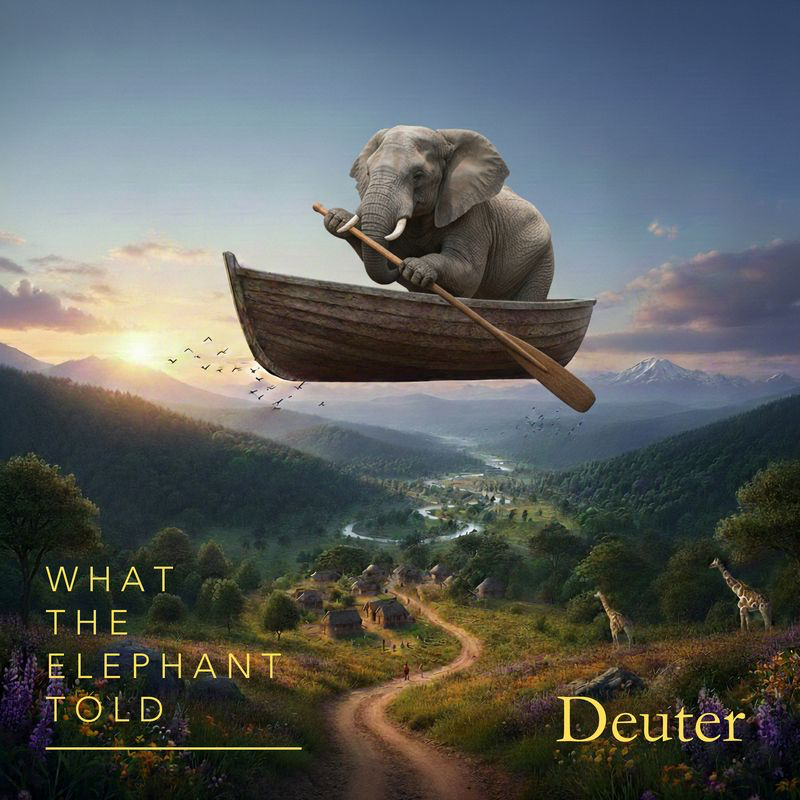
A Quiet Conversation Between Music, Nature and the Soul – A Review of Deuter’s What the Elephant Told
Deuter’s What the Elephant Told makes us slow down and listen, drawing us into a composition that nourishes the soul and feels unusually distinct. From its opening notes, the album creates an unhurried space where piano, flute, strings, reeds and synthesised sounds come together with remarkable delicacy. It is music that does not ask to be hurried through. It invites us to stay with it.
Released through Curve Blue, the album continues Deuter’s long musical journey through ambient, new age and contemplative music. Inspired partly by his admiration for the Sheldrick Wildlife Trust and its family of rescued elephants, the album explores the connection between human beings and the natural world without trying to imitate African music. The elephant is its inspiration, but the musical voice remains entirely Deuter’s own.
Deuter – A Pioneer With a Distinctive Voice
Georg Deuter, known simply as Deuter, is a German new age instrumentalist and recording artist whose music has acquired a distinctive meditative character through his blending of Eastern and Western musical influences. Born in Falkenhagen, Germany, in 1945, he was fascinated by the sounds of nature and musical instruments from childhood. He taught himself the guitar, flute, harmonica and, in his own words, “just about every instrument” he could get his hands on.
A near-fatal car accident while he was working as a journalist changed the direction of his life and eventually led him towards music. He later travelled extensively through Asia, studying Indian music and searching for spiritual and creative inspiration.
His first release, D, appeared in 1970 and combined acoustic and electronic elements with ethnic instrumentation and sounds from nature. It helped establish the musical language that would make Deuter one of the pioneers of the New Age movement.
More than five decades later, his standing in the genre remains considerable. He has recorded and released more than 60 albums and has developed an extraordinary command of instruments including flute, recorder, guitar, koto, shakuhachi, sitar, Tibetan singing bowls, santoor, bouzouki, piano and keyboards. His contribution was recognized in 2016 with Zone Music Reporter’s Lifetime Achievement Award. His 2015 album Illumination of the Heart was also among the finalists for Album of the Year and Best Meditation/Relaxation Album in the organization’s industry voting.
That background matters when listening to What the Elephant Told. This is not an artist experimenting casually with ambient music. It comes from someone who has spent decades developing a musical language of his own.
An Album Inspired by Elephants
The inspiration for the album comes partly from Deuter’s admiration for the Sheldrick Wildlife Trust, a major wildlife conservation organization in Kenya known especially for its pioneering work rescuing, rehabilitating and reintegrating orphaned African elephants and other animals into the wild.
The connection appears in the track titles. Several compositions carry Swahili names associated with elephants living under the care of the Trust. Yet the music itself does not attempt to reproduce African rhythms or instruments. It remains recognizably Deuter.
That makes the concept more appealing. Rather than borrowing an African musical identity, Deuter lets the elephant enter his own musical world. The animal becomes a source of reflection on memory, dreams, nature, connection and the quiet presence of another living being.
What Makes the Album Unique
The album sits comfortably within ambient, new age, meditation and relaxation music, but it does not come across as generic mood music. There is a clear sense of authorship in the way Deuter handles his instruments and arrangements.
One of the things that gives the album its character is the space he leaves around the music. Notes are allowed to emerge, linger and disappear. Instruments enter gently, sometimes seeming to answer one another, and then recede without demanding a dramatic conclusion.
This spaciousness feels particularly welcome today. Deuter seems deliberately to be moving against the current of a world that is always asking us to move faster, respond quicker and consume more. His music asks for very little from us except that we slow down.
Independent Review of the Tracks
Kumbukumbu (04:37) begins with piano and occasional electronic sounds that create a curious, almost otherworldly atmosphere. “Kumbukumbu,” meaning “Memories” in Swahili, is an apt beginning for a journey that gradually moves between the familiar and the mysterious.
Mapambazuko (08:52) unfolds patiently, allowing its musical textures to settle rather than pushing towards an obvious climax. It is a good example of Deuter’s ability to make slowness feel purposeful rather than empty.
Nymphaea (04:33) brings a lighter, delicate presence to the sequence. It is relatively brief, but its role is important in maintaining the album’s continuous, flowing character.
What the Elephant Told (12:46) is the longest composition and the obvious centrepiece. The flute leads the way while strings and reeds add warmth and lift, with synthesised sweeps expanding the musical space. Its extended duration works in its favour, allowing the composition to develop without hurry. Most importantly, it leaves the question in the title open: the listener is free to imagine what the elephant might have said.
Pollen Path (07:42) continues the album’s gentle movement through natural imagery. The music has a light, floating quality and resists the temptation to become overly dramatic, keeping us within the album’s contemplative mood.
Ndoto za Tembo (09:48), meaning “Dreams of the Elephant,” takes the album’s central idea a step further. Selected as the first single, it encourages us to imagine the inner world of another living creature rather than viewing nature only from a human perspective.
Laini na Kubwa (09:26) begins slowly before changing direction, with piano leading the way and flute adding colour. Different instrumental combinations gradually emerge, giving the piece a sense of discovery while retaining the album’s calm character.
Kumbatio la Tembo (05:20) closes the album beautifully. A nostalgic whistle-and-flute quality gives the piece a windswept feeling, and the music gradually eases towards silence. The ending feels natural because Deuter never tries to manufacture a grand finale.
The Album’s Purpose and Mission
At the heart of What the Elephant Told is a simple idea that feels increasingly valuable: we need to slow down if we want to notice what surrounds us.
Deuter has always created music that encourages inner peace and contemplation, and here that quality is placed alongside a concern for elephants and the natural world. The album does not preach a message about conservation. Instead, it creates an emotional space in which the listener can think about our relationship with other forms of life.
There is something quietly effective about this approach. Rather than telling us what to think, Deuter gives us time to think.
Its Place in Ambient and New Age Music
Within ambient and New Age music, What the Elephant Told feels comfortably at home alongside works intended for meditation, relaxation and reflection. Yet it has more personality than a recording designed simply to create a pleasant background atmosphere.
Deuter’s decades of experience, his familiarity with both Eastern and Western musical traditions and his command of a remarkable range of instruments are all audible in the way the pieces are shaped. The music can certainly accompany meditation, reading, rest or quiet evenings, but it also rewards the listener who gives it undivided attention.
Take Away
What impressed me most about What the Elephant Told is the feeling that Deuter never tries too hard. The album does not overwhelm us with elaborate arrangements or dramatic gestures. It simply creates a beautiful musical space and allows us to inhabit it.
I was particularly drawn to the way the elephant remains an inspiration rather than becoming a gimmick. Deuter does not try to imitate the sounds of Africa or pretend to translate the thoughts of an elephant into music. Instead, he lets the idea of the elephant lead us towards questions of memory, dreams, nature and our own capacity to listen. The album feels especially relevant in a time when silence has become increasingly difficult to find. Its greatest strength may therefore be its willingness to leave room—for the music, for thought and eventually for silence itself.
I would recommend What the Elephant Told to anyone who enjoys ambient, New Age, meditation and relaxation music, but also to listeners who simply want to step away from the relentless pace of everyday life for a while. Deuter’s message arrives quietly, note by note. And perhaps that is exactly why it stays with us.
 Album Review—Aphelion
  Album Review—Surrender
  Album Review—Waiting For Today
  Album Review—In The Stillness Of The Stars
  Album Review—Fractured Reflections
  Album Review—Light, Remembered
  Album Review—Journey