
Album Review—Surrender
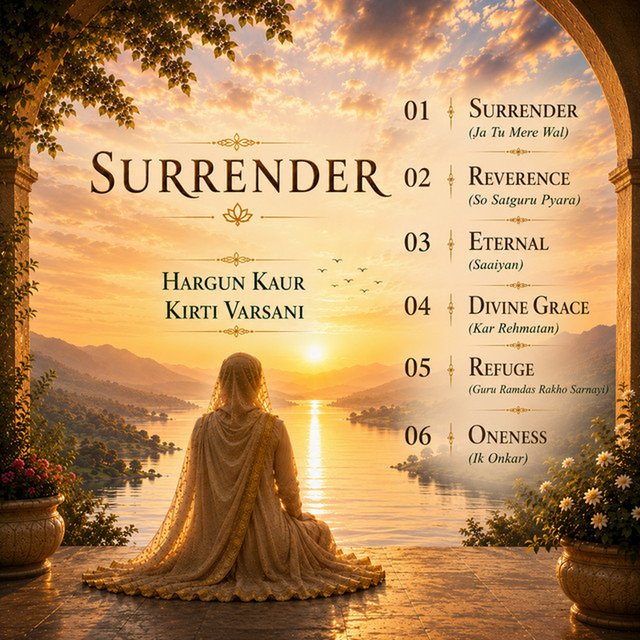
A Devotional Journey Into Stillness: A Review of Hargun Kaur & Kirti Varsani’s Surrender
There is something quietly compelling about music that does not hurry to make its presence felt. Surrender, the six-track devotional release by Hargun Kaur and Kirti Varsani, belongs to that space. Released on July 27, 2026, the record draws upon traditional Punjabi shabads and sacred texts while placing them within a contemporary musical setting. The result is a work that looks toward devotion not as spectacle, but as an inward experience of reflection, faith and stillness.
Kaur and Varsani have been creating devotional music together since 2014, and that long association is central to the character of the release. Kaur brings the emotional centre through her vocals, while Varsani shapes the musical environment around them. Their collaboration brings together Kaur’s Punjabi roots and Varsani’s long experience in devotional composition, creating a meeting point between inherited spiritual traditions and contemporary listening sensibilities.
From Surrender to Oneness
The album’s six tracks have a discernible spiritual progression. Surrender (Ja Tu Mere Wal) opens the journey, followed by Reverence (So Satguru Pyara) and Eternal (Saaiyan). Divine Grace (Kar Rehmatan) and Refuge (Guru Ramdas Rakho Sarnayi) continue the movement toward dependence, faith and spiritual refuge before the album arrives at Oneness (Ik Onkar).
This sequencing gives Surrender a sense of purpose beyond being a collection of devotional songs. The movement is from invocation toward release, with the closing track reducing everything to the single sacred syllable of Oneness. It is a fitting conclusion to a record whose musical philosophy is based on allowing the listener to pause rather than constantly demanding attention.
A Meeting of Tradition and the Contemporary
One of the most interesting aspects of Surrender is the way traditional sacred material is being presented to a contemporary audience. The release does not attempt to discard its devotional heritage in pursuit of modernity. Instead, traditional shabads and sacred texts are adapted for musical performance alongside original lyrics by Hargun Kaur.
That balance is important. Sacred music carries associations, histories and emotional meanings that cannot simply be reproduced through production techniques. The contemporary setting therefore serves its purpose when it creates an accessible space for those traditions rather than overwhelming them. Surrender is conceived precisely in that spirit, giving the devotional material room to breathe.
Hargun Kaur’s Vocal Presence
Hargun Kaur’s role is especially significant because the voice becomes the principal human connection between the sacred material and the listener. Known as a singer, lyricist and harmonium player, Kaur brings experience across classical and contemporary musical expressions and has performed in more than five languages.
On Surrender, her vocals move between chant and melody, reinforcing the contemplative character of the music. Rather than treating devotional singing merely as a vehicle for a tune, the approach places emphasis on the emotional and meditative quality of the voice. This makes the record suitable not only for attentive listening but also for moments of reflection and quiet personal engagement.
Kirti Varsani’s Musical Architecture
If Kaur provides much of the emotional centre, Kirti Varsani provides the musical architecture surrounding it. Varsani has spent decades composing devotional music, including extensive work associated with Maninagar Shree Swaminarayan Gadi Sansthan. That background gives him a strong understanding of sacred repertoire and the musical sensitivity required to approach it respectfully.
His arrangements on Surrender are described as giving the songs space to breathe, and this restraint is central to the record’s identity. The music is not presented as an attempt to create dramatic peaks at every opportunity. Instead, the arrangements support the gradual inward movement of the songs, allowing the devotional character to remain at the forefront.
The Quiet Strength of Oneness
The closing Oneness (Ik Onkar), at just 2:17, is perhaps the most revealing track in the sequence. After five longer pieces, the album concludes with the distilled idea of Oneness. Its position makes it less like another conventional track and more like a final point of arrival.
The choice of Ik Onkar as the concluding expression also brings the album’s underlying idea into focus. The journey that begins with surrender and moves through reverence, eternity, grace and refuge ultimately arrives at Oneness. The musical journey therefore mirrors the spiritual one: gradually letting go until the distinction between the seeker and the sought becomes quieter.
Bonus Track: Chandaliyo
The bonus track Chandaliyo, released separately on July 15, 2026, opens an entirely different window into the creative partnership between Hargun Kaur and Kirti Varsani. Where Surrender is built around stillness and contemplative devotion, Chandaliyo draws its energy from Gujarati raas, garba and folk traditions.
The song evokes the joy of dancing beneath a moonlit village sky, giving the devotional tradition a distinctly celebratory character. Kirti Varsani’s composition, Hargun Kaur’s vocals and Parth Tarpara’s lyrics come together around an especially interesting musical idea: a traditional chhand attributed to Brahmanand Swami, described in the supplied material as being around 200 years old, is brought into a contemporary setting through a modern rap rhythm.
That contrast is what gives Chandaliyo its particular identity. An old devotional form and a contemporary rhythmic language might initially seem to belong to different musical worlds, yet the song deliberately places them together. Rather than presenting heritage as something that must remain untouched to remain authentic, the track demonstrates how an inherited form can be carried into a new generation through a different musical vocabulary.
A Folk Tradition With Contemporary Momentum
The Gujarati character of Chandaliyo is important because the song does not merely borrow the surface energy of garba. Its conception is rooted in the cultural atmosphere of raas, garba and folk music, while the production gives the composition the momentum required for contemporary listeners.
Hargun Kaur’s vocal performance is particularly important here. The song requires a different emotional quality from the inward-looking Surrender. There is reverence in the treatment of the traditional material, but there is also playfulness and movement associated with the folk tradition. That combination allows the song to retain a connection with its devotional source while functioning as an inviting contemporary piece.
The use of a modern rap rhythm underneath an old chhand is perhaps the boldest aspect of the track. It creates a bridge between generations without requiring the newer audience to approach the traditional material through a strictly traditional musical form. Someone already familiar with Gujarati folk traditions can hear the cultural roots immediately, while a younger listener can encounter the same heritage through a rhythmic framework that feels closer to contemporary popular music.
Two Sides of One Creative Partnership
Placed alongside Surrender, Chandaliyo becomes more than a bonus track. Together, the releases reveal the breadth of the Kaur-Varsani partnership. Surrender turns inward, creating an atmosphere of contemplation, surrender and spiritual stillness. Chandaliyo turns outward, bringing devotion into the movement, colour and communal energy of Gujarati folk celebration.
Yet the underlying principle remains similar. Both releases take inherited spiritual and cultural material and seek a contemporary means of communicating it. In Surrender, that means creating space for sacred texts and shabads to breathe. In Chandaliyo, it means placing an old devotional chhand within a modern rhythmic setting.
This ability to move between contemplative devotion and celebratory folk expression gives the collaboration a wider musical identity. It suggests that spiritual music need not be confined to a single emotional register. It can be quiet and inward, but it can also be rhythmic, communal and joyful.
A Partnership Rooted in Heritage
The backgrounds of the two artists complement each other naturally. Kaur’s connection with Amritsar and Punjabi musical traditions meets Varsani’s Gujarati roots and long experience in devotional composition. Their work together therefore represents not simply a collaboration between two musicians, but a conversation between different regional and devotional traditions.
That cultural breadth becomes one of the strengths of these releases. Neither tradition is presented as an exotic backdrop. Instead, the music approaches devotional heritage as something living — something that can be contemplated, sung, rearranged and carried forward without losing its connection with its origins.
Take Away
Surrender is a devotional release designed for listeners willing to slow down. Its greatest quality lies in its patience. Through six tracks, Hargun Kaur and Kirti Varsani create a progression from surrender and reverence toward refuge and Oneness, bringing traditional Punjabi sacred material into a contemporary setting without losing its devotional centre.
The bonus Chandaliyo adds an equally interesting dimension to their musical partnership. Its fusion of Gujarati folk traditions, a centuries-old devotional chhand and a contemporary rap rhythm demonstrates how heritage can find new forms of expression without becoming detached from its roots.
Together, the two releases present two complementary faces of devotional music — stillness and celebration, contemplation and movement, surrender and joy. It is this meeting of tradition with contemporary musical expression that gives the work its distinctive character.
 Album Review—Waiting For Today
  Album Review—What the Elephant Told
  Album Review—In The Stillness Of The Stars
  Album Review—Fractured Reflections
  Album Review—Light, Remembered
  Album Review—A Sky That Knows Our Names
  Album Review—Surrender